
You open a well-water testing website and find a basic package, a bigger package, and a comprehensive package with a much longer list of substances.
The basic one feels risky. The comprehensive one feels expensive. You don't know enough about the names in either list to tell whether the difference matters to your house.
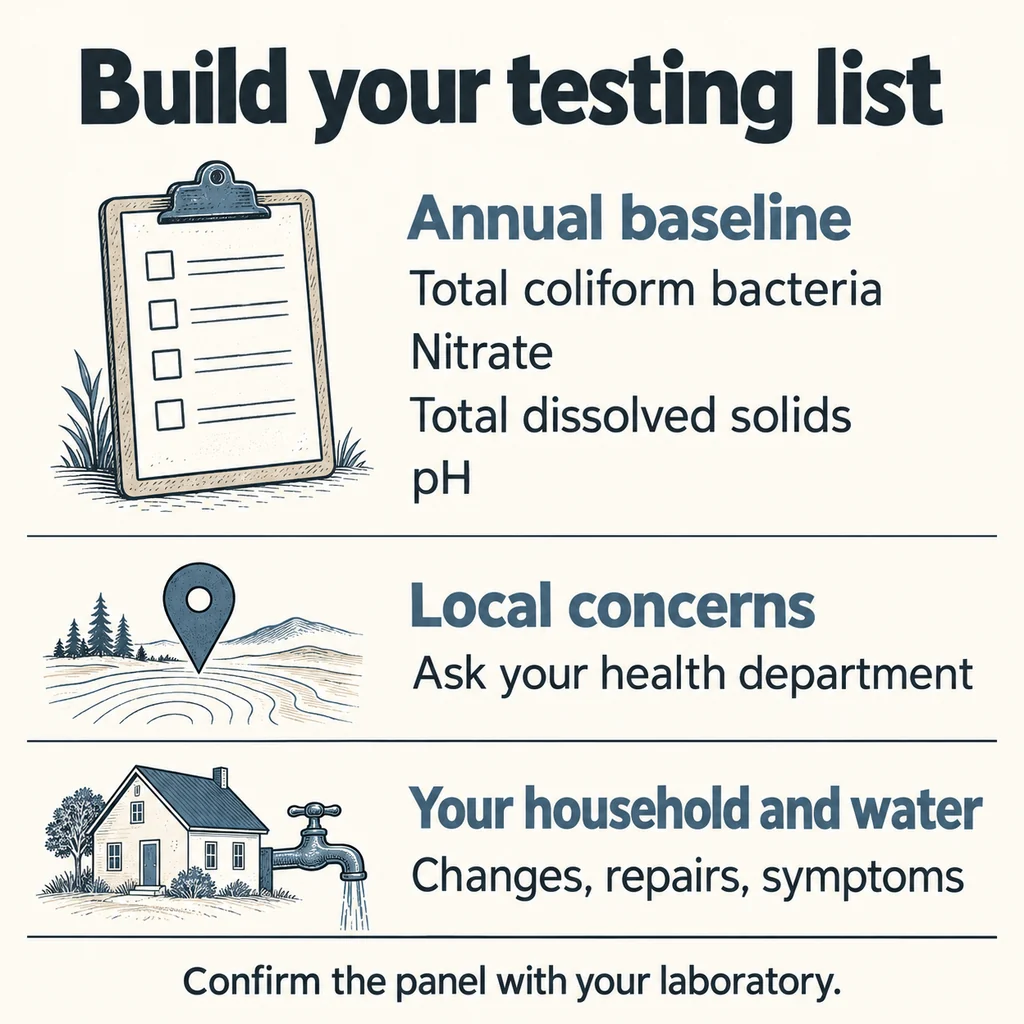
Start with the EPA's recommended annual baseline: total coliform bacteria, nitrate, total dissolved solids, and pH. Then discuss additions based on your location, household plumbing, changes in the water, and the people drinking it.[1]
That gives you a starting point, not a universal shopping list.
What if your water looks clear? Does a test for orange staining also cover drinking-water concerns? And how can you tell whether a package with more tests answers more of your questions?
The useful way to choose is to give each test a job. By the time you order, you should be able to explain what you're investigating, why each addition belongs, and where the sample needs to come from.
View full-size illustration
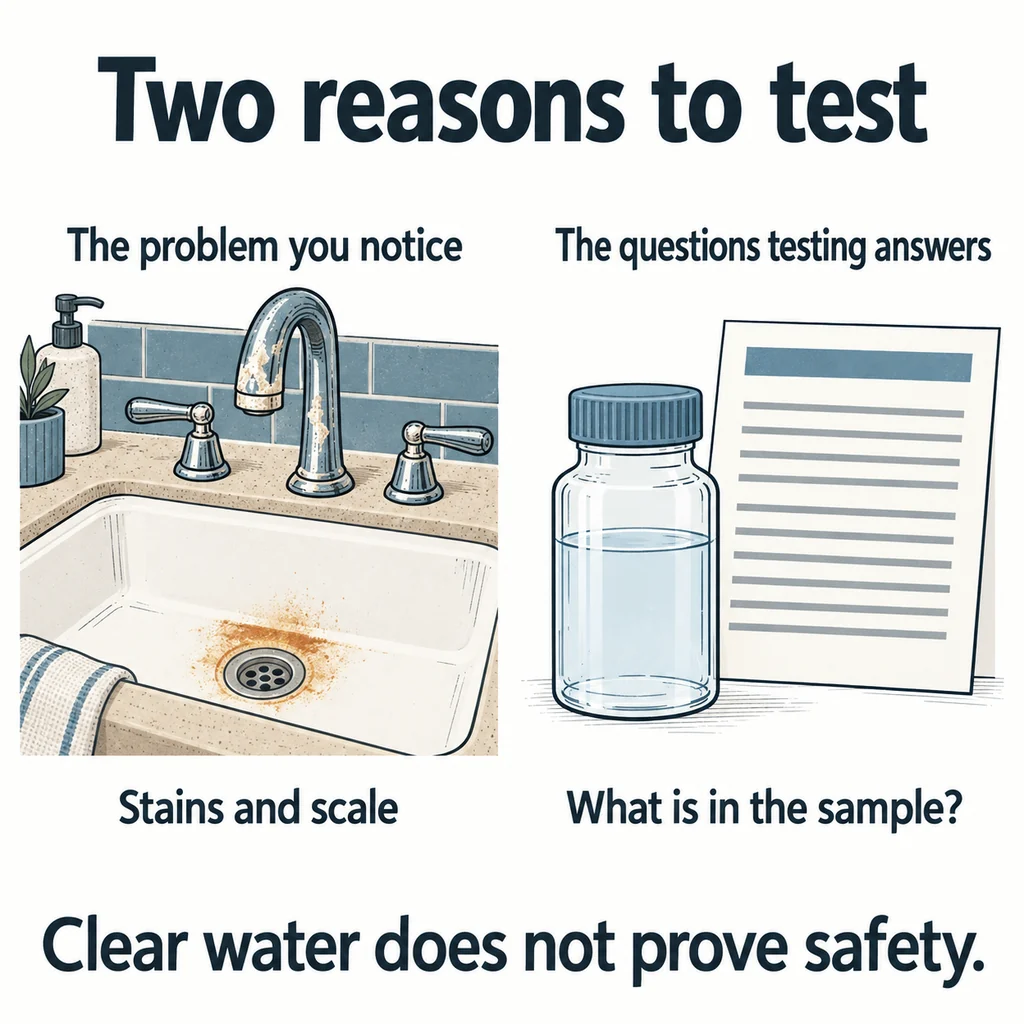
The problem you notice may be different from the problem you need to test for
Orange marks in the toilet get your attention. Something you can't see may not.
The Minnesota Department of Health explains that most common contaminants in its groundwater cannot be detected by taste, sight, or smell. It recommends testing rather than relying on those observations.[2]
That doesn't make your observations useless. It means they have a limited job.
A stain helps you describe a problem to investigate. It doesn't provide a complete list of what is in the water. Clear water doesn't provide that list either.
Keep two questions separate when choosing tests: what could affect drinking-water safety, and what could explain the nuisance or equipment problem you want to fix?
Those questions sometimes overlap. They shouldn't compete for space on the order simply because one problem is more visible.
For example, you might need to investigate recurring stains while also bringing routine drinking-water testing up to date. Buying an iron-only test would address the stain investigation without replacing the routine work.
The same distinction applies after treatment. Removing an unpleasant symptom doesn't establish that every health concern has been addressed. Your test results can only speak to what was actually measured.
Begin with the annual baseline, and know what each result is doing
The EPA recommends annual testing of private wells for total coliform bacteria, nitrates, total dissolved solids, and pH.[1]
Write those names on your preliminary list. Don't assume that a package called “basic well testing” includes all of them. Open the actual list and check.
Total coliform testing looks for a group of indicator bacteria. According to Minnesota's health department, finding them can indicate that surface contamination has entered the water and that disease-causing microorganisms may be present. It isn't a test for every organism that could cause illness.[3]
Nitrate is a separate health-related concern. Minnesota's guidance explains that consuming too much nitrate can affect how blood carries oxygen, with bottle-fed young infants particularly vulnerable.[2]
Total dissolved solids and pH are different kinds of measurements. They describe aspects of water chemistry rather than giving you a separate result for every possible contaminant. Neither result replaces the bacteria or nitrate test alongside it.
You don't need to become a chemist before ordering. You do need to recognize that these measurements answer different questions.
If a provider offers to substitute a hardness reading for the baseline panel, ask which questions remain unanswered. A hardness result isn't a result for nitrate or bacteria, however useful it may be for another purpose.
A routine panel leaves some questions deliberately unanswered
The annual baseline is a starting point. The EPA also advises testing for other contaminants when there is reason to suspect them and asking the local health department about substances common in the area's groundwater.[1]
This is where the word “complete” can mislead you.
A package is a defined list of analyses. A reassuring name doesn't expand that list. If arsenic isn't included, the package hasn't become an arsenic test because it covers other metals.
Likewise, a report showing acceptable results for everything ordered doesn't establish that an untested substance is absent.
For example, imagine you receive a report with no finding that requires action, then learn that your state recommends investigating an additional contaminant in your area. The original report hasn't become wrong. It answered a narrower set of questions.
Before ordering, ask the laboratory: “What important concerns for my situation would this panel leave out?”
That question is often more useful than asking how many things the package tests. It gives the laboratory a chance to identify a meaningful omission rather than repeat the product description.
You can then decide whether an addition is justified, instead of buying more tests simply to make the list look reassuring.
Let your address help choose the additions, without treating a map as a diagnosis
Your location can change which questions deserve attention. The EPA identifies nearby agriculture, industrial activities, fuel sources, and regional conditions among the reasons to discuss particular testing with local officials.[1]
Ask your county health department, state environmental agency, or Cooperative Extension office what private-well testing they recommend for your area. Provide your location privately rather than posting your full address in a public forum.
Describe what you know. You might mention nearby agricultural land, a known fuel release, or a notice you've received about groundwater. You don't need to guess how contamination travels underground.
For example, the EPA lists nitrate, nitrite, pesticides, and coliform bacteria as testing considerations near intensive agriculture. It identifies volatile organic compounds among the concerns associated with some industrial activities and fuel-related situations.[1]
Those are reasons to seek a suitable testing plan, not proof that your well contains those substances.
State guidance can also be more specific than a national baseline. Minnesota, for example, recommends testing its private wells for arsenic and lead at least once, alongside its recurring testing recommendations.[2]
That example isn't a substitute for guidance where you live. It shows why a national package and your local testing needs may not be identical.
Write down the agency's recommendation and the reason behind it. “Recommended for our area” is more useful than “someone online said to test everything.”
Use stains and scale to add useful tests, not to cancel the safety checks
Once you've covered routine and locally relevant concerns, turn to the problem that sent you searching.
Describe it before naming its cause. “Orange marks return around the toilet waterline” is an observation. “Our well has too much iron” is a conclusion that still needs evidence.
The EPA lists iron, copper, and manganese as considerations when plumbing fixtures or laundry are stained. For scaly residues or poor soap lather, it identifies hardness testing.[1]
You aren't expected to order every listed test automatically. Explain the symptom to the laboratory and ask what would help distinguish the plausible causes.
Include where it happens. A problem at one fixture deserves a different description from something you notice throughout the house. Say whether the change was sudden, recurring, or present when you moved in.
If you're considering treatment, tell the laboratory that too. The information needed to investigate a stain may not be everything a qualified installer needs to assess a particular system.
Don't reverse that relationship by picking a filter first and ordering only the test that appears to justify it.
A useful result should be allowed to change your plan. You might need different equipment, more information, or investigation of the plumbing rather than the purchase you initially had in mind.
Changes in the household or the well can change the timing
An annual reminder is useful, but you shouldn't wait for it when circumstances call for testing sooner.
The EPA advises immediate testing after specified changes, including well-system repairs, significant changes near the well, and changes in water quality such as odor, color, or taste. It also advises testing when groundwater or drinking-water problems are known in the area.[1]
Tell the laboratory about relevant household circumstances. The EPA notes that more frequent testing may be appropriate when young children, older adults, or someone pregnant or nursing lives in the house.[1]
You don't need to share a detailed medical history with a salesperson. Ask your health department or clinician which concerns affect the testing decision if someone has particular health needs.
For example, if a baby will be drinking water from the household supply, raise that before choosing the panel rather than after receiving a generic result. Minnesota's guidance specifically emphasizes testing when babies or young children drink the water.[2]
Also distinguish routine planning from an urgent incident. Flooding or suspected contamination calls for advice about immediate precautions as well as testing. A shopping comparison shouldn't delay that conversation.
If the well has flooded, the EPA advises against drinking or washing with its water and warns you to stay away from a flooded pump because of electrical danger.[1]
Build your testing list at the kitchen table before you spend anything
Take a sheet of paper, your previous reports if you have them, and the details of any package you're considering. This is something you can do this week without touching the well or collecting water.
View full-size illustration
- Draw four columns. Call them “Question,” “Reason to ask,” “Test to discuss,” and “Already included?”
- Add the EPA's annual baseline to your preliminary list. If you have recent results, note their dates rather than assuming they still answer the current question.
- Add any local recommendation you have confirmed. Record which agency supplied it. If you haven't asked yet, write “local guidance needed.”
- Describe your visible or practical problem in ordinary language. Leave the test column open when you don't know which analysis fits.
- Add relevant changes, such as a well repair or a new household testing concern, for the laboratory or health department to consider.
- Check the proposed package against the list. Use “included,” “not included,” or “unclear.” Don't count an unclear entry as covered.
A row might read: “Recurring orange stains; toilet and laundry; ask which staining-related analyses are appropriate; package coverage unclear.”
That's useful because it preserves the question without pretending you have diagnosed the cause.
Leave space for the laboratory to amend your list. You are preparing a conversation, not prescribing a laboratory program to yourself.
Compare packages by missing answers rather than by the largest number
Now compare the package descriptions against your worksheet.
A small panel has a practical advantage when it covers a clearly defined routine need. It can be easier to understand exactly what you're ordering. Its limitation is that relevant additions may be absent.
A broader panel can be useful when several justified questions need answering, especially if previous testing is missing or incomplete. Its limitation is that breadth alone doesn't guarantee the right coverage, sampling plan, or interpretation.
Treat those as trade-offs, not a rule that cheaper is wiser or expensive is safer.
For example, suppose you have a local recommendation for a particular substance and a separate hardness concern. One package includes both; another advertises a longer overall list but doesn't clearly include the locally recommended analysis.
The longer list hasn't settled the comparison. You still need the missing answer.
Ask for the total cost of the testing you actually need, including any required return shipping or separate collections. Compare that with another suitable provider's complete quote, not just its advertised starting price.
If a broad package happens to cover your justified list more conveniently, there's no reason to reject it. You should be choosing it because of its contents and practical fit, not because the word “comprehensive” has done the thinking for you.
The right test can still answer the wrong question if you choose the wrong faucet
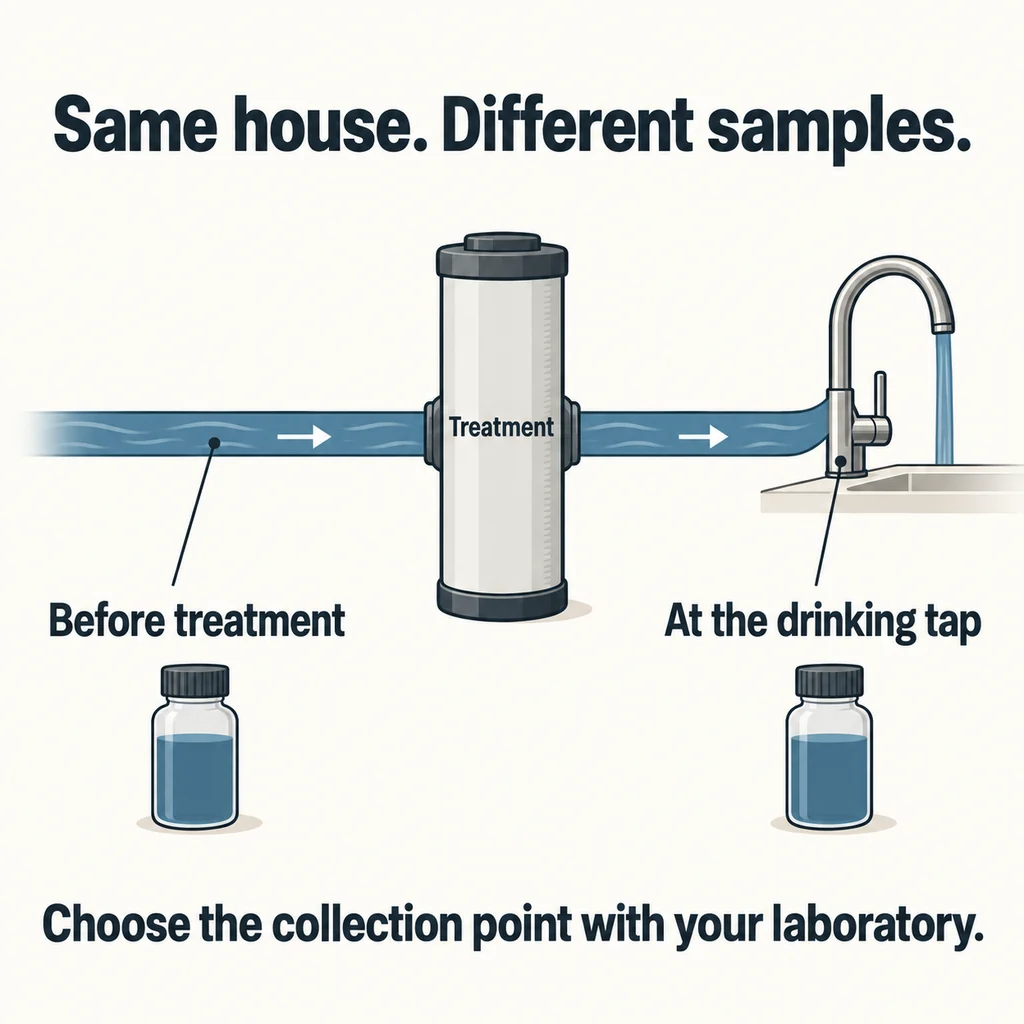
Before you order, tell the laboratory where you intend to collect the water and what treatment is already installed.
A sample from the faucet you drink from answers a different question from a sample intended to describe water entering treatment. Minnesota's household testing guidance recommends testing the cooking or drinking faucet and, when water is treated, sampling after treatment for that purpose.[2]
That doesn't mean the same location automatically suits a treatment-design investigation. Explain the purpose and let the laboratory or qualified professional specify the collection point.
View full-size illustration
For example, you might have a softener serving the house and another unit serving a separate kitchen faucet. “Kitchen sample” doesn't establish which route the water followed.
Write down the exact faucet and the equipment you know comes before it. If you don't know, say so.
Don't turn a bypass valve or open a housing to create an untreated sample on your own initiative. Ask for a suitable, confirmed sampling location.
This is also why a neighbor's results can't finish your worksheet. They may suggest a question worth asking, but they aren't a measurement of your water at your collection point.
Keep the article's main distinction in view: you need the appropriate substances tested in the appropriate sample, not merely a large collection of numbers.
Choose a qualified laboratory, then let its instructions control the collection
The EPA recommends using laboratories certified for drinking-water testing. Your local health department or state certification program can help you find one.[1]
Confirm that the laboratory can perform the analyses you need and accepts samples from homeowners. Minnesota's laboratory-search guidance explicitly separates those questions, allowing users to look for particular analyses and laboratories accepting private-homeowner samples.[2]
A nearby laboratory may offer a practical drop-off route. A mail-in service may make ordering convenient. Neither arrangement removes the need to check qualifications, panel contents, and sample handling.
Ask who will analyze the sample if you're ordering through a service rather than directly from the laboratory.
Then obtain the correct containers and written instructions before collecting anything. Both the EPA and Minnesota guidance direct owners toward qualified testing, and Minnesota specifically tells owners to obtain sample containers and instructions from the laboratory.[1][2]
Confirm the collection location, any faucet preparation, and the applicable delivery requirements. Don't substitute a jar from the kitchen because it looks clean.
If different tests need different collection procedures, ask the laboratory to explain the order and identify which instructions belong to each container. Don't invent a compromise between conflicting directions.
The practical part of testing begins before you turn on the faucet. Have the labels, paperwork, and delivery plan ready so you aren't trying to solve those questions with filled bottles on the counter.
Read the missing tests as carefully as the results you receive
When the report arrives, put your worksheet beside it. Check that the report identifies the sample you intended to submit and contains the analyses you agreed to order.
If something you expected is missing, contact the laboratory. Don't assume an absent line means the substance wasn't detected.
Likewise, “not detected” on a reported analysis and “not tested” are not interchangeable. Ask the laboratory to explain any qualifier, reporting limit, or unfamiliar result rather than turning it into a blanket safety judgment.
Then separate the decisions again. Which findings require public-health advice? Which help explain the nuisance? Which supply information needed for treatment selection?
The EPA advises contacting your public health department when a contaminant exceeds health standards in a sample, with retesting to confirm its presence and concentration.[1]
Don't respond to every concerning result by boiling the water. Minnesota's guidance warns that boiling can increase nitrate concentrations, so the appropriate precaution depends on what is present.[2]
Get instructions suited to the actual result. If anyone is unwell, seek medical advice rather than using the report to diagnose the illness yourself.
Keep the report, final test list, collection details, and any professional recommendations together. That record lets you compare future testing without having to guess what the previous package contained.
Finish with a panel you can explain, including what it cannot tell you
Return to the question that made the package comparison uncomfortable: how much testing is enough?
You won't answer it by finding a kit that promises to test everything. You can answer it more usefully by checking whether your agreed panel covers the routine baseline, the credible concerns for your location and household, and the particular problem you're investigating.
Clear water doesn't remove the need for those questions. Stain testing doesn't replace them. A bigger package earns its place only when its contents help answer them.
Your finished worksheet should show a reason beside each addition. It should also show any unresolved question plainly, whether that's local advice you still need, an unclear package description, or an uncertain sampling location.
For example, you should be able to tell the laboratory: “These are our routine checks. This addition came from local guidance. These tests are to investigate the staining. Please confirm the coverage and where each sample should come from.”
That is a more useful order than “send me your best kit.”
Keep the final list with the instructions. When the results arrive, you'll know which questions you paid to answer and which ones remain open.
Sources
- [1] U.S. Environmental Protection Agency: Protect Your Home’s Water
- [2] Minnesota Department of Health: Well Testing, Results, and Options
- [3] Minnesota Department of Health: Bacterial Safety of Well Water
Sources reviewed September 19, 2026. See our sources and methodology.